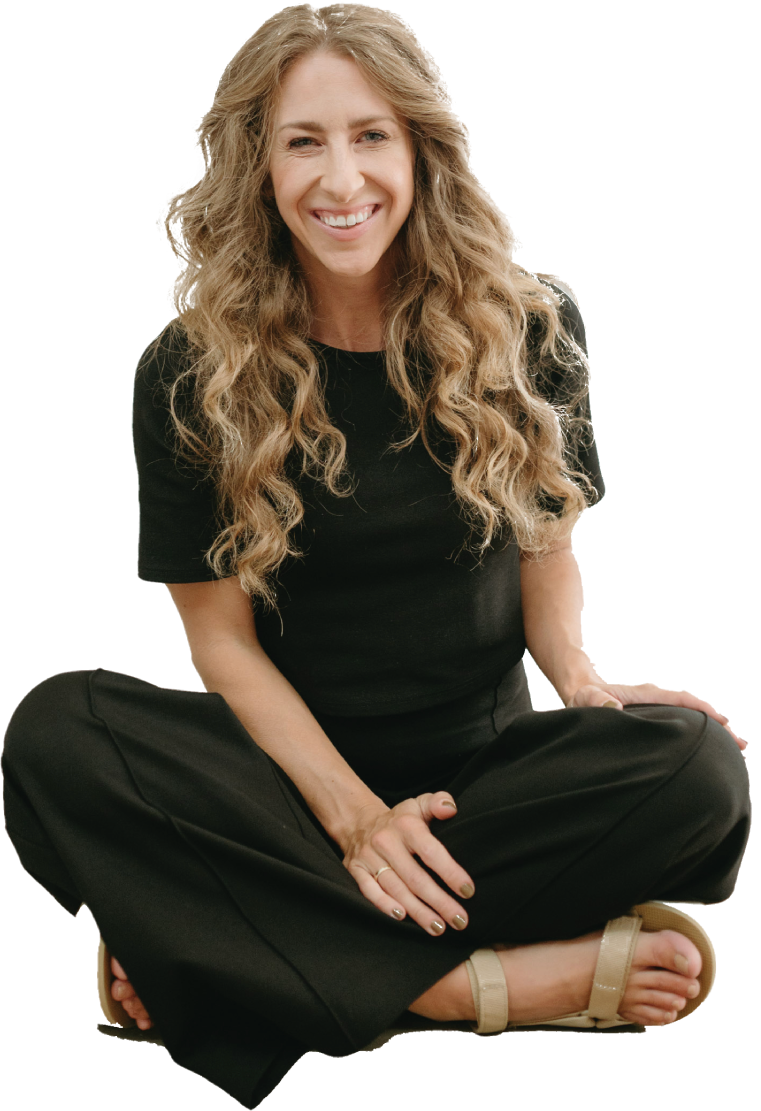
My crew was ready, the cameras were rolling, and someone said, “Okay, Bonnie, whenever you’re ready, go ahead and start recording.”
And I literally froze. Not like a cute little pause. I’m talking deer in the headlights. I want to run away. I want to crawl out of my skin and go live under a rock.
This was day number one of filming the brand new Surface Design Immersion course. For the first time ever, I had no real notes and no teleprompter, just me, a camera, and four people that I loved dearly staring back at me.
I felt so incredibly awkward. I felt exposed and wildly underprepared. I had been thinking about this forever, but these people looking back at me had never seen this part of the process. I’m usually alone doing all of the recording, so they see a polished final version.
And I just felt like they were expecting brilliance to come out of me, and I had none. Like I’d somehow shown up to give a speech and forgotten the entire English language.
And honestly, I wasn’t up for it. I wasn’t enough for it. Who did I think I was? What are we doing here?
It was the pressure cooker of everything coming down to the moment that we finally begin. Months and months of preparing, hiring a professional film crew, and all of a sudden it was time, and I was just like, oh, wait, what?
So I did what any totally rational person would do.
I kicked them all out, kindly and lovingly. But I said, “You guys, I think I need you to leave. I’ve got to work this out all alone.”
So what happened next was that they left laughing, and I had a little cry all by myself in front of the camera. And Henry, our videographer, would slip in and press record and then tiptoe out.
I filmed lessons alone, three, four, five, six, seven lessons in, with no audience and no pressure, just one take at a time.
And I worked out the weirdness. I worked out the awkwardness. And eventually, I let them back in, but not all at once, one by one.
And it was okay. It was more than okay.
But this course was different because it needed to be different. It needed to show me off the cuff. It needed to show me more conversational. It needed to show my process and where I gather inspiration.
And it needed to be real and raw and messy. And that meant vulnerable too.
And that, my friends, is not my favorite place to be.
I long to feel more comfortable being messy and raw and vulnerable with you, but it’s hard. It’s not my favorite. I almost don’t know how to do it. It’s not where I naturally live.
So I have to try really hard to just show up. What a concept.
So hands-on learning, my whole creative process, was the number one goal that we set out to capture.
Welcome back to The Analog Renaissance. This is a nine part series, and we’re in episode number four, where I’m sharing the eight ways that we’re leaning into this analog moment as creatives and entrepreneurs.
Each episode focuses on one shift that we’ve made over the last 18 months, what it’s done for us, what we’ve learned, how we’ve applied it inside our business, and how you can begin to apply it in yours as well.
In the last episode, we talked about physical proof, creating things that people can hold that deepen their belief. Today builds directly on that.
And if you want more context, you’ll want to listen to the first episode of this series, called The Wake Up Call.
This episode is all about hands-on learning and why designing education that gets people off of their screens, even in an online education system, is the most powerful decision that you can make right now.
Now, this is the setting.
I hired a video team. I flew out my crew. I got my best friend and photographer, Callie, to come too, and we stepped into my garden to film and teach hands-on.
It was 70 degrees, sunny, low humidity, which was such a gift to my hair. It was absolute perfection. Nobody was sweating, nobody was frizzing up, and nobody was freezing.
Truly, the Lord gave us that day.
What we captured was color and inspiration, gathering and creative practice and storytelling and golden sunlight pouring through the leaves, and birds chirping like they knew they were part of the soundtrack, and dahlias brushing against my hand, and chickens running about like feathered supervisors.
And for the first time ever, I filmed Surface Design Immersion in my own garden.
I’ve taught this course since 2018. Since then, I’ve gathered all of my inspiration from my own garden. I’ve re-recorded it every two years, and somehow I had never thought to bring students here, to the place where almost all of my work actually begins.
So then we stepped into my studio to film and teach hands-on.
The scene is my studio. The wallpaper I designed covering the walls, a massive patterned panel across the back, books and florals, color and texture layered everywhere.
Textiles hung. Fabric was stacked. Everything was swatched. Every inch of that room was filled with pattern and story and history.
And it mirrors our world right now.
There is absolutely a print and pattern resurgence happening. Patterned accessories are up by 3,000% on Etsy. The wallpaper market is projected to grow by 28% by 2030. Digital textile printing is up by 100%.
You’re seeing it everywhere. Vogue. Martha Stewart.
It’s called pattern drenching.
Color has arrived. The world is hungry for pattern after years of beige and bland.
And what we’re hearing over and over again is that brands are actively looking for designers with a fresh perspective.
This is why I’m teaching this free workshop that I told you about in the last episode. It’s called the Print and Pattern Revival.
Because, my friends, we are literally in a revival.
It is happening February 11 through the 16th, and I’ll link the sign-up in the show notes, or you can join at bonniechristine.com/revival.
Pattern is having a moment.
From bold wallpaper to checkered mugs to striped pajamas and floral notebooks, the world is embracing color and texture and personality again. We are officially living in the era of pattern drenching, and honestly, I’m so here for it.
If you’ve been noticing it too and thinking, I wonder if I could make patterns, you absolutely can.
And the best way to do it is by using Adobe Illustrator.
It’s where I created my very first repeating pattern over a decade ago, and it’s still the tool that I use and teach today, because it’s designed for this kind of creative work and trusted across the entire industry on a global basis.
Illustrator makes designing seamless repeating patterns feel intuitive. You can easily tweak colors, scale your artwork, and move things around without starting over.
Everything stays crisp because it’s all vector based.
And when you’re ready to put your pattern onto a real product, Illustrator works beautifully with printers, manufacturers, and licensing partners.
So whether you’re creating patterns for your notebooks, your living room walls, or dreaming of turning your creativity into a career, Illustrator helps your ideas go from sketch to look at what I made.
Head on over to our show notes, open Adobe Illustrator, and have some fun.
Pattern is having a moment, and Illustrator is how you join it.
Now, this is the math that takes my breath away.
Every industry, every country, every aisle in the entire world is touched by print and pattern.
Every piece of wrapping paper at Target, every bolt of fabric at your local quilt store, every notebook at Anthropologie, every wallpaper swatch at Spoonflower, someone designs them and they get paid for it.
Our favorite way is through licensing deals, royalty checks, contract work, and print on demand.
This is a multi billion dollar industry with a proven path, and most people still don’t even know that it exists.
The timing is impeccable.
You’re not too late. You’re not early either, but you are not late. Right now, you are right on time.
There is a window of opportunity.
The industry is calling you.
But windows do not stay wide open forever.
Here’s what we know.
Students are exhausted.
Studies show that 65% of online students report higher stress due to video fatigue. People are overwhelmed by endless watching, scrolling, and consuming.
And yet most online education still asks one thing.
Can you watch just one more video?
So this is the opportunity that we saw.
When you design learning that intentionally gets people off of their screens, you immediately stand out.
You become the thing that feels different. The thing people remember. The thing they actually finish.
In a world full of talking heads and endless tabs, hands-on learning is the differentiator.
So the shift that we made was learning by doing.
This is the shift that we have built into every module in Surface Design Immersion.
We stopped designing lessons that end with, “Okay, I’ll see you in the next video.”
And we started designing learning that looks like this instead.
Screen time followed by analog action, in their garden or in their studio, gathering inspiration.
Learning paired with doing, laying out color swatches and gathering ephemera.
Information paired with implementation, sketching and mapping out their collection, pencil in hand.
Ideas paired with proof, holding something in your hand that you made with your own pattern on it.
This became our new rule.
Every module ends with an off-screen action and creates proof of work, an artifact of progress, something you can hold.
What this looks like in practice is a physical mood board created by hand, printed color stories and motif explorations, an art print they design and print themselves, a product created using print on demand, and finally a physical portfolio.
So instead of asking, did you watch the lesson, we can ask, did you make that thing?
And that is when learning stops living in our heads and starts living in our hands.
Nowhere did this shift come to life more clearly than that day in the garden.
Because surface pattern design has never been just about keyboard shortcuts in Adobe Illustrator.
It is about noticing. Living your life. Gathering. Paying attention.
It is about claiming a way of living that is creative and full and present and made by hand.
So for the first time, we redesigned the 2026 course to fully embody that.
We filmed where the work actually begins.
For me, it looks like this.
Picking flowers from the garden. Actually, it starts before that. I pick them out of a catalog first. Then I order them. Then I plant them and watch them grow.
Then I pick them, study their shapes and details, doodle and sketch them by hand, press petals and stems, arrange them, scan them, and translate them into patterns.
I am not a grandiose artist or a prodigy painter.
I don’t have an art degree. I don’t make fine art.
I can hold a brush and pick colors I like, and that’s about it.
Surface pattern design is different.
You don’t have to be a traditional fine artist.
You notice. You gather. You curate. You direct.
You take what you see, trace it, press it, scan it, paint it, and arrange it into patterns that move onto products.
And when learning happens this way, hands-on and immersive, something shifts.
The noise quiets.
Doubt loosens.
The pressure to perform fades.
Because you can see your progress.
And that is when momentum takes over.
Instead of wondering if you’re good enough, you start saying, look at what I made.
That’s it. That’s the whole secret.
So this is your takeaway.
Include screen time paired with action that takes people off the screen and creates proof.
My question for you is this.
What could your student or your audience hold that proves their progress?
It doesn’t have to be elaborate.
It could be a printed checklist, a handwritten reflection, a letter to themselves, a sketch, or a one-page plan taped above their desk.
Even the simplest physical creation is deeply satisfying.
And when learning leaves the screen and enters the real world, people linger longer, they finish more, and they believe in themselves faster.
We spent eight hours that day filming in my garden, and then days in my pattern-filled studio, capturing the simple, grounded magic of surface pattern design.
The noticing. The gathering. The quiet joy of turning something real into something beautiful.
In the next episode, I’ll share what might be the most intentional and delightfully low-tech part of the entire course.
No software. No screens. Just your hands.
And a moment that made everyone on my team stop and say, wait, are we really doing this?
I can’t wait to show you why we believe the future of online education might begin with a box arriving at your doorstep.
My friends, create the beauty that you want to see come alive in the world.
And remember, there’s room for you.